Think your FPGA-based system is secure? Think again. From aerospace control units to connected medical devices, FPGAs are now prime targets for sophisticated attackers. What were once low-risk vulnerabilities buried in hardware are now front-line concerns, and traditional protections like basic secure boot are no longer sufficient.
At Fidus, we design secure, high-performance FPGA-based-systems across a wide range of platforms and industries. Our teams support customers in aerospace, automotive, and medical, and more, helping them meet demanding requirements for functionality, security, and compliance from concept through deployment.
Whether you’re assessing your system architecture or building a new design with security in mind, this guide outlines key considerations for protecting FPGA-based embedded systems at every stage of their lifecycle.guide is your blueprint.
In this blog, we explore the evolving threat landscape and share advanced implementation strategies that go far beyond secure boot. You’ll learn how to defend your FPGA-based embedded systems throughout the lifecycle—from silicon root of trust to runtime monitoring and in-field updates.
The Evolving Threat Landscape for FPGA-Based Systems
As embedded systems increasingly rely on programmable hardware for performance, flexibility, and real-time control, the security of FPGA-based systems has become a critical concern. Threat actors are no longer targeting software alone; they’re exploiting the reconfigurability of FPGAs to access sensitive assets, inject logic, or corrupt system states.
A Shift Toward Hardware-Centric Threats
Traditionally, embedded security focused on software vulnerabilities. But over the past decade, attackers have shifted their focus deeper into the stack, targeting the hardware configuration, boot process, and runtime behavior of FPGA-based designs. Research has shown how adversaries can manipulate bitstreams, extract secrets using side-channel analysis, or even tamper with supply chain components to inject malicious logic.
Fidus engineers regularly conduct threat modeling and architectural reviews to identify and mitigate these types of vulnerabilities before they reach production.
Security Challenges by Industry
Aerospace: Requires deterministic response and DO-254 certification, leaving minimal headroom for security overhead unless it’s architected early.
Automotive: With ECUs and ADAS increasingly networked, the attack surface expands, especially via OTA updates.
Medical: Security breaches risk not only data loss, but also patient safety and FDA compliance. FPGAs in imaging and diagnostics must be hardened from the inside out.
Each industry demands a tailored approach to embedded system security, accounting for regulatory, functional, and operational constraints.
The Cost of Inaction
The consequences of FPGA-targeted attacks go beyond data theft. Security breaches can result in:
Irreparable damage to brand trust and customer confidence
Costly product recalls or field updates
Delays in safety certifications
As FPGAs continue to power intelligent systems at the edge and in the cloud, security must become a first-class design priority, starting from the silicon root of trust and extending throughout the product lifecycle.
Secure boot is the cornerstone of FPGA security, but in modern embedded systems, basic implementations are no longer sufficient. As threat actors grow more sophisticated, system designers must evolve secure boot mechanisms to protect not just the initial load but the entire execution environment.
Challenges in Complex FPGA-Based SoCs: Implementing secure boot in FPGA-based SoCs involves more than validating a bitstream. These platforms often include heterogeneous components—processing systems, AI engines, and custom logic—each with different boot sequences, memory architectures, and security dependencies. Synchronizing these elements under a unified chain of trust can be complex, especially when third-party IP is involved or when the system supports features like partial reconfiguration.
Extending the Hardware Root of Trust: Advanced FPGA security strategies go beyond validating the bootloader. They extend the hardware root of trust into the OS and application layers, ensuring that each stage of execution is cryptographically verified. Techniques such as authenticated boot, measured boot, and attestation allow systems to detect tampering at any point in the lifecycle. In safety-critical sectors like aerospace and defense, these capabilities are rapidly becoming standard.
Extending Trust with Modern FPGA Platforms: Today’s FPGA platforms offer advanced security capabilities that support secure boot, integrated cryptographic engines, and layered protection across logic and processing domains. These features enable designers to build trusted execution environments that ensure only authorized software is loaded and executed. At Fidus, we work with a broad range of FPGAs to implement robust security architectures that support in-field updates, long-term deployment, and compliance with safety and cybersecurity standards
Runtime Security Monitoring and Verification
Secure boot protects the system at power-up, but what happens once it’s live? In many deployments, especially in aerospace and defense, runtime threats represent the greatest risk. That’s why real-time security monitoring is a non-negotiable component of modern FPGA-based embedded design.
Hardware-Based Runtime Verification Techniques
FPGAs are uniquely suited for implementing runtime security verification. Designers can allocate logic for real-time state monitoring, bus integrity checks, or access control enforcement, without burdening the main processor. On supported FPGA platforms, these security monitors can operate independently of the main processor, enabling real-time detection of unauthorized access, configuration changes, or abnormal system behavior.
Fidus routinely implements runtime monitors and isolation zones using programmable logic, empowering clients to detect and respond to threats without sacrificing performance.
Anomaly Detection and System Response
A robust security architecture includes well-defined actions in response to anomalies:
Logging and alerting through secure telemetry
Lockdown or rollback to a known-good configuration
Isolation and partial reconfiguration of compromised logic
These tactics are especially valuable in systems that must operate in the field for years or decades, where security updates and reconfiguration must be done dynamically and safely.
Secure Enclaves and Physical Isolation
In safety-critical and regulated systems, secure enclaves are essential for isolating trusted functions such as cryptographic operations, safety controls, and IP-sensitive logic.
FPGAs make it possible to physically and logically separate these secure regions from general-purpose processing logic. Fidus architects isolation using techniques like dedicated logic partitions, access-controlled interconnects, and runtime monitors—an approach proven effective in medical devices, aerospace controllers, and industrial automation platforms where trust and compliance are non-negotiable.
Performance-Optimized Security Implementations
Security features are often seen as performance killers, but they don’t have to be. In many FPGA-based systems, especially those in aerospace, defense, and high-throughput industrial applications, performance is non-negotiable. That’s why modern embedded designs must balance robust FPGA security with efficient execution.
Fidus specializes in architecting embedded systems that deliver both protection and performance, leveraging advanced silicon features, optimized logic, and targeted hardware acceleration.
Minimizing Latency Without Compromising Security
One of the primary challenges in secure embedded design is maintaining low latency while validating authenticity, integrity, and access control. Techniques like secure boot, runtime authentication, and encrypted data paths can introduce processing delays if not optimized.
Using programmable logic in modern FPGA architectures, Fidus engineers offload time-critical security tasks from general-purpose processors to maintain real-time performance. This approach enables inline encryption, packet inspection, and secure command handling to run with minimal overhead, even in real-time systems.
Benchmarking Security Overhead
Not all security mechanisms have the same cost. For example:
Authenticated boot sequences may only add milliseconds to system start-up.
Runtime monitors embedded in programmable logic often consume less than 5% of FPGA resources.
Inline encryption engines can maintain full data throughput with proper hardware support.
At Fidus, we benchmark different implementation approaches across multiple use cases to help clients select the optimal balance of speed, area, and power.
Hardware-Accelerated Security for Resource-Constrained Designs
In systems with tight resource budgets, such as small-form-factor industrial controllers or medical wearables, hardware acceleration is essential. FPGAs allow designers to integrate custom crypto engines, hash functions, and access control logic without bloating software or degrading responsiveness.
Fidus has delivered secure designs where the total security footprint was under 10 percent of available logic, yet supported authenticated boot, runtime validation, and secure field updates.
FPGA-Specific Attack Vectors and Countermeasures
FPGAs introduce a unique set of vulnerabilities that are not present in fixed-function silicon. Attackers are increasingly targeting the programmable nature of these devices, making it essential to address both the bitstream and the underlying logic fabric.
Bitstream Protection and Configuration Risks: The bitstream is the blueprint of the design. If it’s exposed or intercepted, attackers can reverse-engineer logic, inject malicious functionality, or clone the device. That’s why encrypted and authenticated bitstream loading is now considered a baseline requirement.
Side-Channel and Fault Injection Attacks: FPGAs can leak information through power, timing, or electromagnetic emissions. These side-channel vulnerabilities allow attackers to extract cryptographic keys or system behavior patterns. Physical attacks like voltage glitching or laser fault injection can also disrupt logic and force the system into insecure states. Fidus implements countermeasures, including logic redundancy, constant-time execution paths, and isolation techniques to reduce attack surfaces in critical regions.
Learning from Real-World Failures: Several public case studies have shown how improper handling of configuration interfaces or debug ports can lead to full system compromise. Designing with security in mind—not as an afterthought—is key to avoiding these pitfalls.
Implementing a Comprehensive Security Lifecycle
Securing an FPGA-based system isn’t a one-time task—it requires lifecycle thinking. From provisioning keys during manufacturing to securely updating firmware in the field, each stage introduces its risks.
Managing Cryptographic Key Lifecycles
Keys are at the heart of most FPGA security features. Mismanagement—like hardcoding, insecure storage, or lack of rotation—can undermine even the strongest encryption.
Secure Firmware Updates
In connected systems, update mechanisms are often a backdoor waiting to be exploited. A secure update strategy requires:
Cryptographic verification of update payloads
Rollback protection to prevent downgrading
Isolation of the update process from critical system functions
Fidus designs firmware update frameworks that are secure, efficient, and adaptable to a variety of deployment environments and FPGA technologies.
Handling Partial Reconfiguration
FPGAs that support dynamic reconfiguration offer flexibility, but also new attack surfaces. If not tightly controlled, an attacker could load unauthorized logic. We architect reconfiguration processes with built-in access control, integrity checks, and isolation to ensure security isn’t compromised mid-operation.
Industry-Specific Compliance and Certification
Security is only part of the equation—regulated industries also demand verifiable compliance. For sectors like aerospace, automotive, and medical, FPGA-based systems must meet strict safety and assurance standards without compromising security.
Meeting DO-254, ISO 26262, and IEC 62304 Requirements: Each standard introduces unique demands. DO-254 (aerospace) requires traceability and verification of logic at the HDL level. ISO 26262 (automotive) focuses on functional safety in electronics. IEC 62304 (medical) addresses software lifecycle risk management. Fidus supports secure FPGA development processes that align with these standards, combining safety and security through requirements tracing, tool qualification, and rigorous design partitioning.
Security and Compliance—Not Either-Or: Security features can’t jeopardize safety certification. That’s why we design dual-path workflows where safety-critical functions are isolated from security logic. For example, secure boot and encryption functions are validated in parallel with safety domains, ensuring both pass regulatory audits.
Certification-Ready Design Practices: Fidus brings pre-qualified IP, documented workflows, and cross-functional review processes to accelerate certification timelines. Whether it’s a high-reliability aerospace controller or a secure medical imaging pipeline, we help get your product to market with confidence.
Integrating TPMs and Hardware Security Modules with FPGAs
To strengthen system-level security, many embedded designs now pair FPGAs with dedicated hardware security elements, such as Trusted Platform Modules (TPMs) or Hardware Security Modules (HSMs). These components provide tamper-resistant storage and cryptographic operations, complementing the flexibility of programmable logic.
Choosing the Right Integration Approach: There’s no one-size-fits-all model. In some designs, TPMs manage device identity and secure boot keys. In others, HSMs offload intensive cryptographic tasks like key generation or digital signing. Fidus helps clients evaluate tradeoffs and select the best-fit architecture based on performance, lifecycle, and compliance needs.
FPGA-TPM Co-Design in Real Products: We’ve integrated TPMs in real-world applications where secure provisioning, attestation, and firmware validation were essential. These architectures allow FPGA logic to verify TPM-generated signatures or authenticate access to protected resources, without relying on insecure software paths.
Design and Debug Considerations: FPGAs offer the flexibility to tailor interface logic (e.g., SPI, I2C, or PCIe) for TPM or HSM connectivity, but care must be taken to secure those interfaces and avoid debug backdoors. Fidus provides interface-level hardening, secure initialization routines, and test infrastructure that maintains security across the development lifecycle.
Future-Proofing FPGA Security
Threats evolve—and so must the defenses. As FPGAs are deployed in more connected, autonomous, and critical systems, future-ready security requires proactive design, not reactive patching.
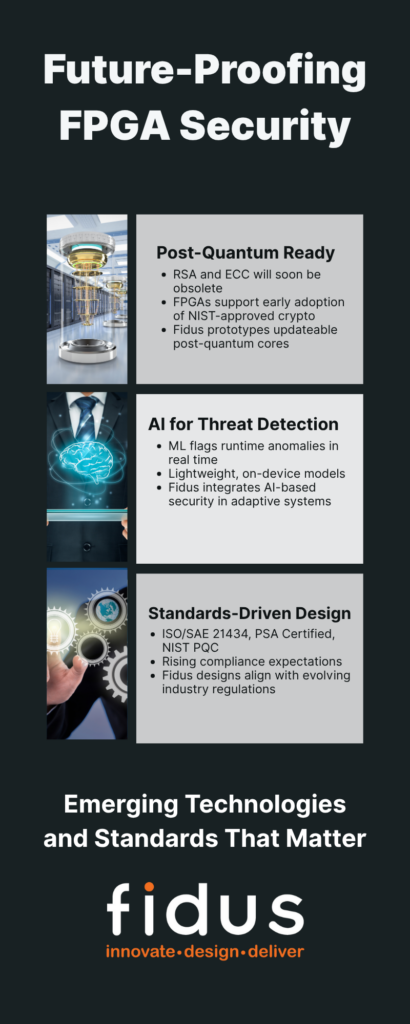
Preparing for Post-Quantum Cryptography: Quantum computing will eventually break today’s public key cryptography. Standards bodies like NIST are finalizing post-quantum algorithms to replace RSA and ECC. FPGAs, with their reprogrammable logic, are ideal for early adoption. Fidus is actively prototyping lattice-based and hash-based crypto cores that can be updated as standards mature.
AI and ML in Threat Detection: Machine learning isn’t just a risk—it’s also a tool. On-device anomaly detection using lightweight ML models can flag unusual runtime behavior, especially in systems where traditional IDS is too heavy. Fidus engineers are exploring AI-enhanced runtime security in FPGA designs that must adapt to dynamic conditions.
Following Emerging Security Standards: From Platform Security Architecture (PSA Certified) to updates in ISO/SAE 21434 for automotive cybersecurity, the regulatory bar is rising. Fidus stays ahead of these developments by participating in industry working groups and aligning client architectures with evolving best practices.
Conclusion
Securing an FPGA-based embedded system is no longer just about locking down the bootloader. From bitstream protection to runtime monitoring, secure firmware updates, and emerging threats like quantum attacks, today’s designs demand a comprehensive, forward-looking security strategy.
Fidus brings deep expertise across the entire FPGA security lifecycle—from architecture and implementation to compliance and field sustainment. Whether you’re designing a mission-critical aerospace controller, a connected medical device, or an industrial automation platform, our engineers can help you build in the protection your system needs, without compromising performance or certification goals.
Contact Fidus to speak with a security architect or explore our Secure Embedded Systems services.
Verified numbers on satellite payload processing, from EO launch growth to space-grade silicon and thermal limits, each traced to the institution that published it. Plus six widely quoted figures that failed the check.
FPGA and RF engineering services or a new hire: How to decide
Engineering is the hardest role in aerospace and defense to fill. Three questions show whether your FPGA or RF gap needs a new hire or FPGA engineering services.
Why Payload Processing Is Moving from Ground to Orbit
Earth observation launches are nearly tripling, but downlink capacity per spacecraft hasn't kept up. Deciding what to process in orbit is now a hardware decision made years before launch.