
Why Payload Processing Is Moving from Ground to Orbit
Earth observation launches are nearly tripling, but downlink capacity per spacecraft hasn't kept up. Deciding what to process in orbit is now a hardware decision made years before launch.
Back to top

Software outsourcing has a mature playbook. Specs, sprints, code reviews, deployments. Engineering teams that have run successful software outsourcing engagements tend to carry those expectations into embedded work. The assumptions hold until hardware enters the picture, and then the differences start costing real money.
The software development outsourcing market reached $564 billion in 2025. At that scale, the practices are well documented. Vendor evaluation criteria exist. Contract templates exist. Communication cadences are well understood. Engineering leaders who have outsourced web applications, mobile features, or cloud services know how to manage the relationship.
Embedded systems outsourcing operates in a different environment. The embedded product engineering services market is $1.58 billion, a fraction of general software outsourcing, and the smaller market reflects a fundamentally different set of constraints. When firmware runs on custom hardware, when testing requires physical boards, and when a bug can mean a PCB respin instead of a code push, the vendor management practices that work for software start breaking in specific, predictable ways.
Good embedded engineering vendors exist, and the market for their services is growing. The friction comes from applying software outsourcing assumptions to embedded engagements where those assumptions don’t hold. Understanding where the models diverge is the first step toward managing the relationship well.
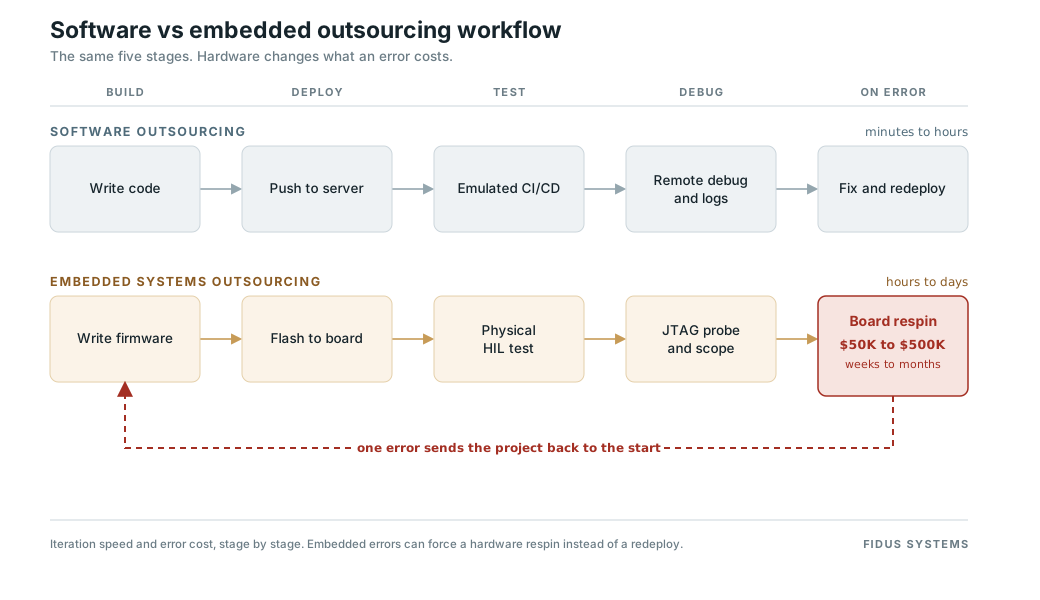
Software outsourcing follows a pattern most engineering leaders can recite from memory. The vendor gets access to your repo, spins up a development environment, writes code against your specs, and deploys through your CI/CD pipeline. Iteration cycles are measured in hours. Rollbacks are a button press. Testing happens in emulated environments that approximate production with reasonable fidelity.
Embedded development breaks each of those assumptions.
| Dimension | Software outsourcing | Embedded systems outsourcing |
|---|---|---|
| Deployment | Push to server or cloud | Flash to physical hardware |
| Iteration speed | Minutes to hours | Hours to days (hardware in the loop) |
| Testing | Automated CI/CD, emulated environments | Physical boards, real sensors, environmental chambers |
| Debugging | Remote debugging, logging, stack traces | JTAG probes, logic analyzers, oscilloscopes |
| Toolchain | Language + framework (vendor brings their own) | Cross-compilers, vendor-specific SDKs, exact versions mandated by silicon |
| Cost of errors | Code fix and redeploy | Potential board respin ($50K to $500K+, weeks to months of delay) |
The cost asymmetry in the last row is what makes the other differences matter. A software bug caught after deployment is an incident. An embedded firmware bug that causes a hardware respin is a project-level setback that shifts timelines by months. Engineering leaders who have only managed software vendors aren’t calibrated for that risk, and the vendor management practices they rely on don’t account for it.
In software outsourcing, the vendor works in their own environment. They clone the repo, set up local dependencies, and develop against your APIs. You never ship them anything physical.
Embedded outsourcing requires hardware. The vendor needs reference boards, development kits, and custom test fixtures that match your production hardware. If the firmware targets a custom PCB rather than an off-the-shelf evaluation board, someone has to build those boards, ship them, track revisions, and manage the firmware versions running on each unit.
This creates logistics that software engagements don’t have. Every board in circulation is a configuration management problem. Board revisions need tracking. Firmware images need version control tied to specific hardware builds. When the vendor reports a bug, the first question is which board revision they’re running, because behavior can differ between Rev A and Rev B of the same design.
Debugging changes too. Software developers attach a debugger to a running process from anywhere in the world. Embedded developers connect JTAG probes and logic analyzers to physical boards. Remote debugging of FPGA-software interactions is possible but significantly slower than working with the hardware on the bench. When timing-sensitive issues require an oscilloscope to observe signal behavior at nanosecond resolution, “remote” stops being viable.
Embedded outsourcing partners who work in your timezone and can receive hardware overnight produce measurably faster iteration cycles than partners twelve time zones away. A board that ships Monday and arrives Tuesday means Tuesday debugging. A board that ships Monday and arrives next week means a week of dead time on hardware-dependent work.
A software vendor that knows React can pick up Vue in a sprint. A Python shop can ramp on Go in a few weeks. The tools are general-purpose, widely documented, and transferable.
Embedded toolchains are specific to the silicon vendor, the processor family, and the individual device. A Zynq UltraScale+ project requires AMD’s Vitis toolchain. An STM32 project uses STM32CubeIDE. A TI Sitara project uses Code Composer Studio. Each toolchain has its own build system, linker configuration, and debugging workflow. Experience with one does not transfer cleanly to another.
RTOS selection adds another layer. FreeRTOS, Zephyr, VxWorks, and QNX each have distinct configuration models, scheduling behaviors, and driver frameworks. Each RTOS exposes dozens of configurable parameters: task priority schemes, memory allocation strategies, interrupt handling policies, timer resolutions. Misconfiguration produces bugs that are subtle, difficult to reproduce, and expensive to diagnose under production conditions. A task priority inversion that causes a watchdog timeout under load will pass every bench test and fail in the field.
The vendor evaluation question that matters for embedded is: “Have you shipped production firmware on this specific silicon with this specific RTOS?” The distinction matters because the learning curve for a new silicon-RTOS combination is measured in months, not sprints. A vendor claiming general embedded expertise without specific platform experience will spend your project budget climbing that curve.
Contract language needs to reflect this. Specify exact toolchain versions, compiler flags, and RTOS versions in the statement of work. “Latest version” as a specification creates integration problems three months into the engagement when the vendor updates a toolchain and breaks binary compatibility.
Software testing has a well-understood hierarchy: unit tests, integration tests, end-to-end tests, staging environments. Each level adds confidence. Emulated environments approximate production closely enough that most bugs found in staging also reproduce in production.
Embedded systems break that approximation. A firmware module that passes every unit test on a host machine can fail on target hardware because of memory alignment constraints, interrupt timing, or peripheral register behavior that the emulator doesn’t model. Simulation covers logic but misses the physics of real hardware.
Temperature-dependent behavior is the canonical example. Firmware that runs reliably at room temperature may exhibit timing failures at the edges of the operating range. Crystal oscillators drift with temperature. Voltage regulators shift under load. Memory timing margins narrow. These effects don’t exist in simulation, and they account for a meaningful share of field failures in embedded products.
Power behavior is another gap. Sleep and wake transitions, brownout detection, and power sequencing interact with firmware in ways that depend on board layout, decoupling capacitor placement, and load transients. Testing these interactions requires the actual hardware in an environmental chamber, not an emulated peripheral model.
Outsourcing contracts need to require hardware-in-the-loop validation, not just simulation results. Define pass/fail criteria for performance metrics (interrupt latency, task response time, memory footprint) on target hardware at the extremes of the operating envelope.
Binary size is another constraint that surprises teams coming from software outsourcing. Cloud applications have effectively unlimited memory. Embedded firmware runs in kilobytes or megabytes of flash, and every library inclusion, debug symbol, and logging framework consumes space that the hardware cannot expand. Without binary size budgets specified in the contract, vendors optimize for functionality and discover the size constraint during integration, when the options for fixing it are expensive.
A vendor who delivers firmware that “works on the eval board” has completed the easy part of the work. The hard part is making it work reliably on production hardware under real-world conditions.
The differences above don’t mean embedded outsourcing is unworkable. They mean the management practices need specific adjustments.
Vendor proximity matters more in embedded than in software outsourcing. Physical proximity to your hardware lab affects iteration speed on every hardware-dependent task. Partners who operate in your timezone and can receive boards quickly reduce the dead time that accumulates between “ship the board” and “start debugging.” Firms like Fidus Systems, with engineering capacity distributed across North American design centers, eliminate the shipping delays and timezone friction that slow hardware-coupled development. A 99% first-pass success rate across 4,000+ projects reflects what happens when the design team owns FPGA, firmware, hardware, and signal integrity under one roof: fewer integration surprises between disciplines, and faster cycles from prototype to production.
Engineering leaders moving from software outsourcing to embedded outsourcing don’t need a completely new playbook. They need targeted adjustments at the points where hardware coupling changes the economics and logistics of the engagement. Start with the contract: specify toolchains, hardware targets, and physical test requirements before evaluating vendors. Then evaluate partners on platform-specific experience, not general embedded capability. The rest of the relationship follows from getting those foundations right.
If you’re scoping an embedded outsourcing engagement and want to pressure-test your approach, start a conversation with Fidus.

Earth observation launches are nearly tripling, but downlink capacity per spacecraft hasn't kept up. Deciding what to process in orbit is now a hardware decision made years before launch.

When should you outsource heterogeneous computing design? Keep the CPU, FPGA, GPU and NPU architecture call in-house, and get outside validation before board layout, while changing the partition is still cheap.

An industrial vision customer wanted RFSoC converter performance in a 65x65mm module. It shipped at 65x90mm. Where that extra 25mm went, why the power solution set the form factor, and what a board you can barely probe teaches you at bring-up.

Trust us to deliver on time. That’s why 95% of our customers come back.