
Why Payload Processing Is Moving from Ground to Orbit
Earth observation launches are nearly tripling, but downlink capacity per spacecraft hasn't kept up. Deciding what to process in orbit is now a hardware decision made years before launch.
Back to top
AI demos can be impressive, but product teams know that a high-performing model is only one part of a successful deployment. Fidus’ Person Re-Identification demo makes that point clear. Running on an AMD Ryzen™ AI–based SAPPHIRE EDGE AI Mini-PC and powered by the Fidus Vision Stick, the demo showcases a processing-intensive vision workload while highlighting the practical engineering needed to move from a promising proof of concept to a reliable edge AI product.
Many AI demonstrations focus on model accuracy or benchmark performance. In reality, companies developing AI-enabled products face a much broader set of challenges. Models must be integrated into embedded complex systems, optimized for target hardware, trained on representative data, and validated through repeatable testing processes. Overlooking any of these areas can introduce risk, delay schedules, and increase development costs.
Person Re-Identification is a computer vision technique that identifies and tracks individuals across multiple camera views, even when those individuals leave and re-enter a scene or move between cameras.
Applications include:
Unlike traditional object detection, Person Re-Identification requires models to recognize the same individual under varying conditions, including changes in lighting, camera angles, clothing visibility, and environmental factors. In production, that creates a broader systems problem involving data quality, model performance, hardware constraints, and validation. Fidus helps customers address that complexity by engineering the full solution around the AI, not just the model itself.
A key component of the demo is the Fidus Vision Stick. The Vision Stick uses an FPGA bridge to allow x86 processors to process multi-camera GMSL video data through an M.2 slot. This architecture enables compact systems to capture and process multiple video streams without requiring specialized external hardware.
In the demo, the Vision Stick acts as the connection point between the camera infrastructure and the AI processing pipeline, delivering the video data required for real-time analysis. By combining the Vision Stick with AMD Ryzen™ AI technology, the demo showcases how high-performance vision systems can be implemented within a compact edge computing platform
The demo runs on a Ryzen™ AI–based Sapphire Edge AI Mini-PC, showcasing the growing trend toward edge AI deployment. While cloud-based AI remains important, many organizations are moving inference workloads closer to where data is generated. Edge deployment can reduce latency, improve privacy, lower bandwidth requirements, and increase system responsiveness.
However, moving AI workloads to embedded and edge platforms introduces new challenges:
Successfully deploying AI at the edge requires more than simply exporting a trained model. It requires a deep understanding of both the AI pipeline and the target hardware platform.
One of the biggest misconceptions in AI development is that model training represents the majority of the effort. In practice, integration often consumes a significant portion of the development cycle.
For the Person Re-Identification demo, the AI model is only one component of a larger system that includes:
Bringing these components together requires expertise across software, embedded systems, hardware acceleration, and system architecture.
This multidisciplinary approach is a core strength of Fidus. With extensive experience spanning embedded software, FPGA development, hardware design, and systems engineering, we help customers bridge the gap between AI research and deployable products.
AI models that perform well during development do not automatically perform well in production environments. Performance profiling and optimization are essential steps in the deployment process.
For our demo, we evaluated execution behavior on the target platform to identify bottlenecks and optimize resource utilization. This included analyzing:
The goal was not simply to make the model run, but to ensure it runs efficiently and predictably within system constraints. These optimization activities are often overlooked early in development, only to become critical issues later in the product lifecycle. By addressing performance considerations early, organizations can avoid costly redesigns and accelerate time-to-market.
Many AI projects begin with publicly available datasets and pre-trained models. While these resources are valuable starting points, production systems rarely operate in the same conditions represented by generic training data.
Real-world deployments often require:
As a result, organizations frequently need to collect, curate, and label custom datasets to achieve acceptable performance. Our Person Re-Identification demo highlights this reality. Achieving reliable results requires more than selecting a model architecture, it requires a disciplined approach to data collection, training, validation, and continuous improvement.
Understanding these challenges helps organizations establish realistic expectations and avoid common pitfalls during AI adoption.
Traditional software testing methodologies do not always translate directly to AI-based systems. Unlike deterministic software, AI systems can exhibit behavioral changes resulting from:
This makes repeatable validation particularly important. As part of our development process, Fidus emphasizes regression-style testing strategies that help teams monitor performance over time and detect unintended changes before deployment.
Effective AI testing can include:
Establishing these practices early helps reduce development risk and improves confidence in production deployments.
The excitement surrounding AI often focuses on models and algorithms. Yet many project delays and failures stem from challenges outside the model itself.
Successful AI products require disciplined engineering practices across:
| Area | Why It Matters |
| System Integration | Ensures AI functions reliably within the complete product |
| Hardware Optimization | Maximizes performance and efficiency |
| Data Engineering | Improves model accuracy and robustness |
| Verification & Testing | Reduces deployment risk |
| Lifecycle Management | Supports long-term maintainability |
These capabilities are especially important for organizations developing embedded, edge, and hardware-enabled AI solutions where system-level constraints play a major role.
This is where Fidus delivers value. Our teams combine expertise in hardware, embedded software, FPGA development, AI integration, verification, and systems engineering to help customers navigate complexity and bring innovative products to market faster.
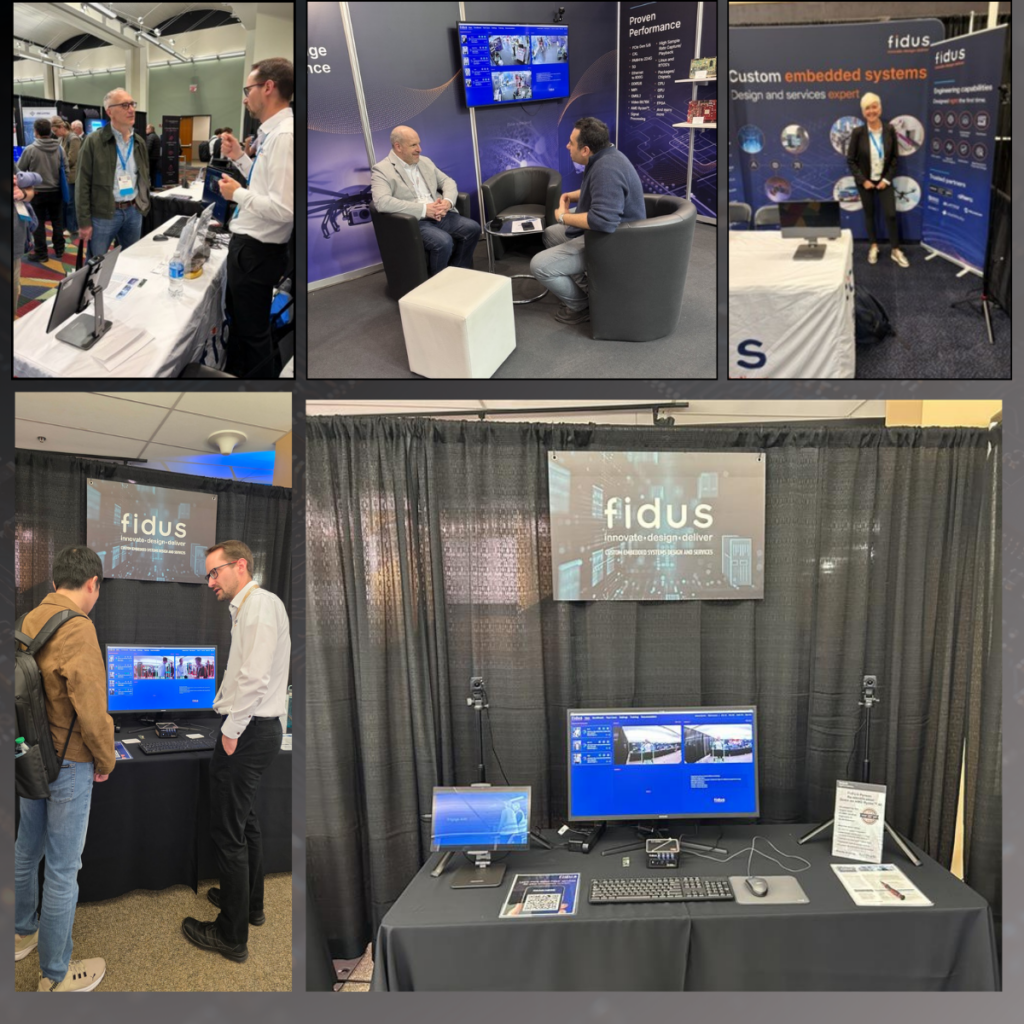
The Person Re-Identification demo showcased at Embedded World 2026, FPGA Boston, and AMD ECS is more than a technology demonstration. It represents the engineering realities companies face when developing AI-enabled products. From integrating AI into larger systems and optimizing performance on target hardware to training with custom data and implementing robust testing frameworks, successful AI deployment requires a comprehensive engineering approach.
The Person Re-Identification demo generated significant interest at Embedded World Germany 2026, where attendees had the opportunity to see the application running live and speak directly with the engineers behind it. During the event, Scott sat down with Ken Briodagh, editor of Embedded Computing Design, to discuss the demo, the hardware platform, and the engineering considerations involved in developing AI applications for edge systems.

At Fidus, we help companies reduce technical risk, accelerate development timelines, and build AI-powered products that are ready for real-world deployment. If your team is exploring edge AI, computer vision, embedded AI, or hardware-accelerated machine learning solutions, we’d welcome the opportunity to discuss how our embedded expertise can help bring your next product to market with confidence.
Earth observation launches are nearly tripling, but downlink capacity per spacecraft hasn't kept up. Deciding what to process in orbit is now a hardware decision made years before launch.
When should you outsource heterogeneous computing design? Keep the CPU, FPGA, GPU and NPU architecture call in-house, and get outside validation before board layout, while changing the partition is still cheap.

An industrial vision customer wanted RFSoC converter performance in a 65x65mm module. It shipped at 65x90mm. Where that extra 25mm went, why the power solution set the form factor, and what a board you can barely probe teaches you at bring-up.
Trust us to deliver on time. That’s why 95% of our customers come back.