
Direct RF Sampling vs Superheterodyne: Choosing an RFSoC Front End
Direct RF sampling now reaches 18 GHz. How to choose between direct sampling and superheterodyne for an RFSoC front end, and the filter, clock and decimation specs that choice sets.
Back to top

Direct RF sampling now reaches 18 GHz. How to choose between direct sampling and superheterodyne for an RFSoC front end, and the filter, clock and decimation specs that choice sets.

An SRAM adaptive SoC puts configuration scrubbing, interrupt recovery and TMR into your satellite payload design. A flash-based rad-hard FPGA removes that work and caps compute. Here’s how to scope it before choosing the part.
Engineering is the hardest role in aerospace and defense to fill. Three questions show whether your FPGA or RF gap needs a new hire or FPGA engineering services.

When should you outsource heterogeneous computing design? Keep the CPU, FPGA, GPU and NPU architecture call in-house, and get outside validation before board layout, while changing the partition is still cheap.

Software outsourcing has a mature playbook. It starts breaking the moment hardware enters the picture. Here is where embedded engagements diverge on toolchains, testing, and the cost of an error, and how to adjust your vendor management before a firmware bug turns into a board respin.

Embedded projects don’t fail inside disciplines — they fail at the handoffs. How vendor structure determines who owns your integration boundaries

Discover how Fidus’ Person Re-Identification demo on a Ryzen™ AI–based SAPPHIRE EDGE AI Mini-PC highlights AI integration, optimization, custom-data training, and repeatable testing for faster product development.

Most embedded design projects fail for reasons that traditional vendor evaluation never uncovers. The risk isn’t in capability—it’s in how disciplines interact, how decisions are validated, and how early mistakes propagate into costly hardware failures. This guide outlines the criteria that actually predict success when selecting an embedded systems design partner.

Most embedded design projects fail for reasons that traditional vendor evaluation never uncovers. The risk isn’t in capability—it’s in how disciplines interact, how decisions are validated, and how early mistakes propagate into costly hardware failures. This guide outlines the criteria that actually predict success when selecting an embedded systems design partner.
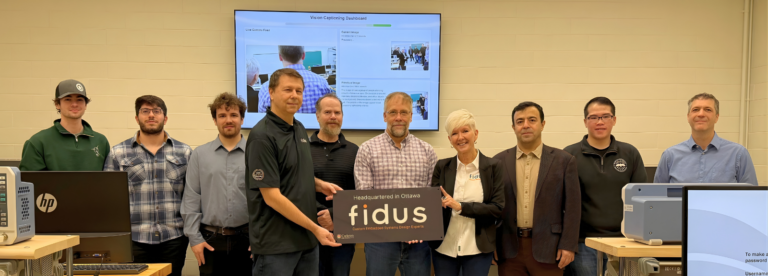
Fidus is partnering with Carleton University to support hands-on FPGA education through industry-aligned hardware, practical learning environments, and direct exposure to modern design workflows. This collaboration reflects a shared commitment to strengthening Canada’s engineering talent pipeline and bridging the gap between academic learning and real-world embedded-system development.
Trust us to deliver on time. That’s why 95% of our customers come back.