Engineering leaders across North America are balancing rising system complexity with shrinking internal bandwidth. FPGA logic grows more demanding. Embedded software expands faster than teams can staff. Board-level requirements become more constrained and tightly integrated. Meanwhile, schedules stay aggressive, hiring stays slow, and regulatory expectations tighten.
The tipping point usually comes during a roadmap review. Schedules drift, senior engineers are pulled into firefighting, and a new requirement lands that touches secure boot, system validation, and silicon level decisions. Leaders can clearly see the risk forming. What they usually cannot see is the path forward without sacrificing quality or velocity.
This playbook is written for those leaders. It draws from hundreds of projects that involved FPGA architecture, embedded firmware, high-speed board development, AI acceleration, and full system integration. The goal is simple. Help you understand when to seek outside support, how to choose the right engagement model, and how to build a partnership that protects your roadmap instead of complicating it.
Know when you need external help
Most engineering teams reach for help the moment pressures become unmanageable. There is a better way. The real signals appear earlier and are more predictable.
You are nearing the threshold when schedules slip despite more effort, when senior engineers spend more time in the lab than in design, or when the project demands knowledge your team has not developed at production depth. These moments do not reflect weakness. They reflect the growing complexity of modern systems.
The decision to look outside usually comes down to two forces. A bandwidth crunch or a capability gap. Bandwidth issues mean your team knows exactly what to build, but cannot move fast enough. Capability gaps appear when an unfamiliar domain arrives, and the learning curve becomes a schedule risk.
The strongest leaders protect their core. Proprietary algorithms, architectural intent, customer-defining features, and strategic platform knowledge stay internal. Everything around that core can be accelerated through external embedded systems design services. FPGA implementation, firmware development, design for test, signal chain alignment, and integration support often benefit from specialists who have already solved these problems many times.
Teams fall behind not because they lack talent but because demand scales faster than headcount.
This is the point where the right partner becomes a force multiplier rather than a dependency.
Choose an engagement model that supports your strategy
There is no single correct way to work with external engineers. The model must match the structure and maturity of your own team.
Staff augmentation is direct. You add people to your team. It works when architecture is solid, tasks are clear, and internal leadership has time to manage and review work. Many companies use this when the problem is primarily bandwidth.
Outcome-based engagements take a different approach. Instead of buying hours, you define a result. A subsystem, a feature, a verification environment, or a hardware software integration milestone. This model works when your internal team needs progress but cannot afford the overhead of coordinating every detail.
Some of the most effective programs use a blended model. Internal architects own direction while specialists handle implementation, validation, and documentation. This approach provides clarity, ownership, and throughput without giving up control.
The right model becomes obvious when you look at complexity, timeline pressure, and internal bandwidth. Low complexity favors staff augmentation. High complexity and aggressive timelines often require a partner who can own planning, risk mitigation, and validation. Mixed domain projects benefit most from blended collaboration where both teams contribute their strengths.
Understand the hidden costs and how to avoid them
Every external engagement begins with onboarding. It takes time for a new team to understand your architecture, coding conventions, toolchains, and workflows. Leaders often underestimate this cost. When onboarding is rushed, misalignment surfaces later during integration or validation.
Another invisible cost is the effort required to maintain consistency. Even strong engineers must adapt to your processes. Without clear expectations, teams sink time into rework, refactoring, and late stage debugging.
Some companies discover the highest cost comes from selecting a team that looks less expensive on paper. A low rate does not reflect efficiency. When senior internal engineers must step in to correct work, the true cost doubles. Projects involving complex FPGA systems or deeply integrated embedded software rarely succeed with inexpensive generalists. Precision matters more than billing rate.
A realistic plan includes time for ramp-up, architecture reviews, tooling alignment, verification cycles, documentation, and lab workflow integration. These elements protect quality and prevent surprises.
The lowest rate often leads to the highest actual cost.
Strong partners raise these considerations early because they understand how they influence schedule and quality.
Make the partnership work
The most successful engineering partnerships start small. A pilot project prevents assumptions, validates technical quality, and gives both teams a real sense of how collaboration will function under pressure.
Clear definitions make everything smoother. Technical interfaces, coding expectations, documentation standards, review cycles, and communication rhythms should be established up front. Ambiguity slows work and creates friction.
Large embedded programs also demand balanced teams. A group made entirely of senior engineers can stall because essential implementation and validation work is delayed. Projects move fastest when architects, implementers, verification specialists, and documentation support operate together.
Time zone alignment might appear minor but has a major impact. When teams work in the same or adjacent hours, questions are resolved immediately and integration accelerates. Keeping engineering based in North America also protects intellectual property, simplifies reviews, and eliminates the communication delays that often undermine offshore models.
A strong partnership is built on clarity, transparency, and shared expectations. When these elements are present, progress becomes predictable, and setbacks become manageable.
Avoid the common failure points
Most project issues trace back to the same patterns. Requirements that are not fully understood evolve into redesigns. Status reports that show green while deliverables slip create blind spots. Documentation that trails behind implementation results in knowledge loss. None of these problems are inevitable, but they appear when teams push for speed without structure.
One engineering leader described a troubled engagement this way. Every weekly report looked positive, but every sprint review told a different story. This disconnect happens when teams optimize for comfort instead of accuracy. Transparent communication is not optional for complex development.
Documentation deserves particular attention. When engineers move on to new tasks or leave the project, undocumented decisions become technical debt. A strong partner maintains documentation discipline and treats it as part of the delivery, not an afterthought.
The remedy is simple. Regular technical reviews, clear architectural documentation, visibility into progress, and a culture that values early risk reporting.
Measure what matters
Engineering leaders want predictability. The best predictors of success have little to do with hours worked and everything to do with the quality of execution.
First-time right performance is one of the strongest indicators. When early prototypes behave as expected, it signals that architecture, implementation, and validation were handled correctly. Low defect churn shows that the team understands the system and has applied discipline throughout the process.
Documentation quality is another major factor. Well-formed design notes, test plans, and bring up guides reduce risk and accelerate future iterations.
Customer return rates also reveal capability. If many companies come back repeatedly, it suggests long term trust and consistent performance. This metric is often more meaningful than the size of a portfolio.
When leaders focus on these metrics, they gain a clearer view of engineering health and partner reliability.
How to select a firm that supports complex engineering
Selecting the right engineering design company requires more than looking at a list of services. You need a partner who understands the challenges of modern embedded systems. FPGA logic alone is not enough. Deep firmware experience is not enough. High-speed board development is not enough. Complex products require all of these skills working together.
A strong portfolio shows real complexity and system-level thinking. You should see projects involving silicon bring-up, embedded firmware, real-time processing, FPGA acceleration, and full product integration. The examples should feel familiar to the systems you are building, not generic.
It is also important to understand who will work on your project. Some companies present senior engineers during the sales process but staff the project with junior engineers during execution. Ask directly about the team roles and experience levels.
Reference conversations bring clarity. Ask about communication, defect patterns, schedule integrity, and documentation. These are the details that influence outcomes.
A pilot engagement is often the best proof. It shows how the partner approaches risk, quality, and collaboration before you commit to a larger scope.
The right partner strengthens your team; the wrong partner slows it down.
Conclusion: Why leaders trust Fidus for complex embedded systems design
Modern engineering programs succeed when they combine vision with execution. The companies that stay ahead are the ones that scale wisely, protect their core knowledge, and bring in specialists when complexity demands it.
Fidus supports that strategy by bringing depth in FPGA architecture, embedded firmware development, board-level engineering, and complete system integration. Our engineers work entirely in North America, which protects your intellectual property, accelerates collaboration, and keeps communication aligned. With more than twenty years of experience and the largest contingent of AMD-certified engineers outside of AMD, the team delivers accuracy and predictability for programs that cannot afford missteps.
Fidus focuses exclusively on design. We do not manufacture, and we do not dilute attention across unrelated service categories. The work centers on solving advanced engineering problems with clarity, discipline, and first-time right execution.
When your roadmap requires a trusted engineering team capable of handling complex embedded systems, Fidus provides the expertise, structure, and technical depth needed to deliver reliable outcomes.
From Classroom to Career: Inside the Fidus × Carleton University FPGA Learning Initiative
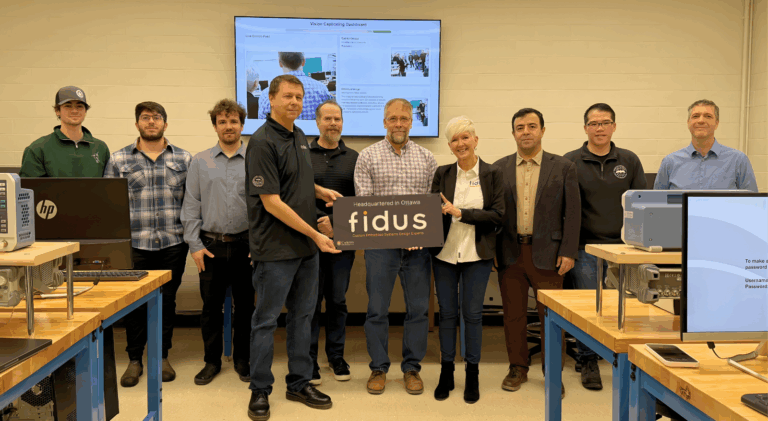
Fidus is partnering with Carleton University to support hands-on FPGA education through industry-aligned hardware, practical learning environments, and direct exposure to modern design workflows. This collaboration reflects a shared commitment to strengthening Canada’s engineering talent pipeline and bridging the gap between academic learning and real-world embedded-system development.
What to Expect When Partnering with an Embedded Systems Design Services Company
Hardware doesn’t move at software speed — and that’s okay. Here’s what decision-makers need to know about realistic timelines when partnering with an embedded systems design services company like Fidus.
Hardware-Based Security for Embedded Systems: Exploring Trusted Platform Modules (TPMs)
As embedded systems become more connected and exposed to cyber threats, software-only security is no longer enough. Trusted Platform Modules (TPMs) provide a hardware root of trust that anchors device integrity, safeguards cryptographic keys, and enables secure boot processes. This blog explores how TPMs strengthen embedded systems, from their core architecture and advanced features to real-world applications in automotive, industrial, and IoT devices — and what engineers must consider to future-proof TPM security against emerging threats.